
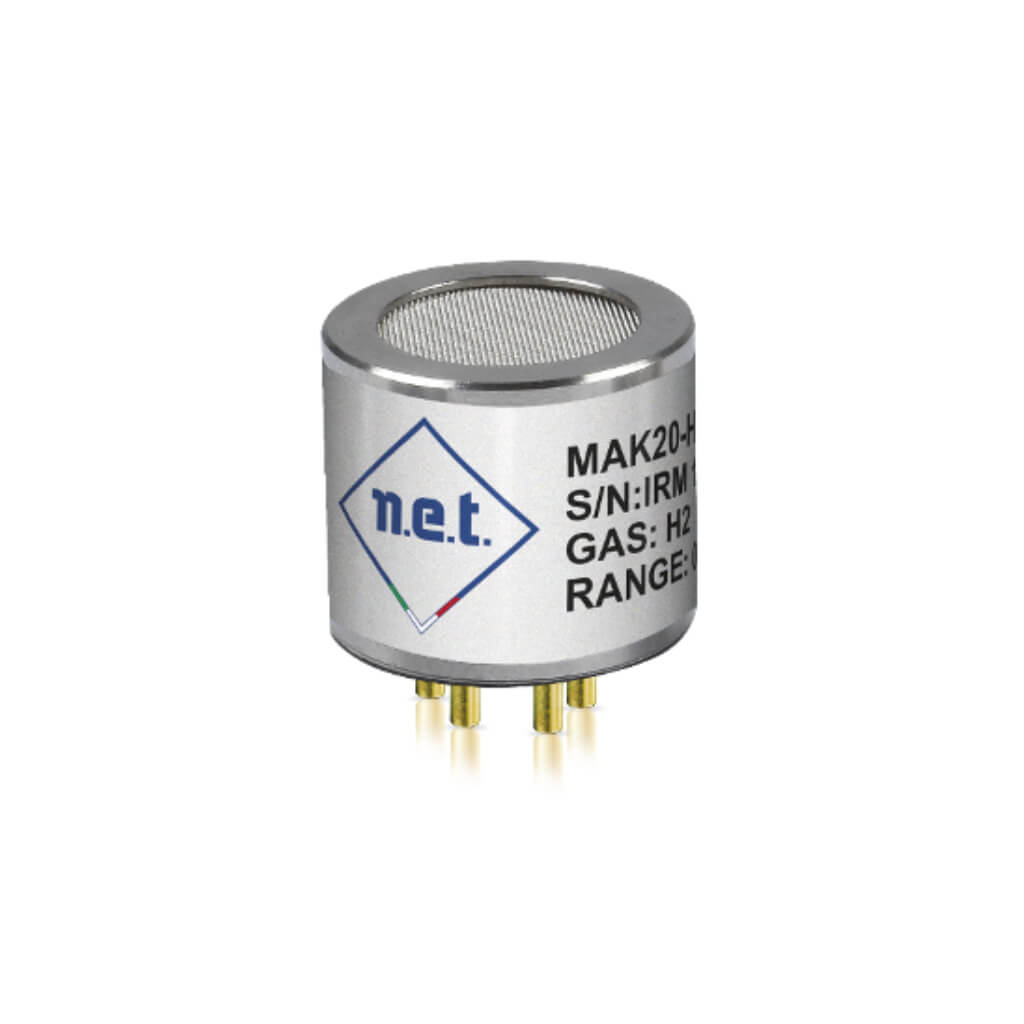
Advantages of our MAK 20mm Thermal Conductivity Gas Sensors:
- Individual calibration and testing, for measurements you can trust
- Extended temperature range (-25 °C to +85 °C), for use in any environment
- Internal microprocessor, for advanced signal processing
- Standard industrial size, to fit existing detectors
- Low power consumption
- Fast T90 response time (< 1.4 s), for critical and life-saving applications
- Outstanding long-term stability of 0.1 % F.S./year
- Broadest available ranges, up to 100 % volume
- Digital communication, for ease of integration
- Solid, rugged construction with stainless steel enclosure
With the application of MEMS (Micro Electronic Mechanical Systems) technology, NET is making the power of thermal conductivity gas sensors available for the broadest range of Hydrogen detection applications. By employing very repeatable, high-volume CMOS (Complementary metal-oxide-semiconductor) MEMS technology, the new NET KATHAROMETER GAS TECHNOLOGY is lowering production costs and the typically high power consumption of thermal conductivity gas sensors.
MAK sensors detect hydrogen concentrations in the air by measuring the change in thermal conductivity of the gas mixture. Thermal conductivity sensors are most effective when detecting gasses with low molecular weight, which correspond to greater thermal conductivity. Hydrogen possesses the highest thermal conductivity of all known gasses.
