NDIR Technology: Principles and Implementation in Gas Sensing
The operating principle, operational advantages, and application of Non-Dispersive Infrared (NDIR) Sensors.
Infrared (IR) sensors detect Gas concentrations by measuring the absorption of infrared light at specific wavelengths. An infrared light beam passes through the Gas and reaches the collecting optics, which splits the beam and directs it through filters onto the IR detectors.
The Operating Principle of NDIR Sensors
The operating principle of a Non-Dispersive Infrared (NDIR) Gas Sensor is based on the property of certain molecules to absorb light at specific wavelengths (or colours), which are characteristic of their molecular structure.
The absorption characteristics are defined as molecular vibrational energies associated with stretches, bends, or rotations, and depend on the molecular structure of the Gas.
For the IR energy to be absorbed, meaning for the vibrational energy to be transferred to the molecules, the frequency must correspond to the frequency of the vibrational mode. Consequently: specific molecules absorb IR radiation at precise frequencies, and every Gas has a unique and well-defined light absorption curve in the infrared spectrum.
When the IR radiation passes through a volume containing specific Gas, only the frequencies corresponding to the vibrational mode are absorbed, while the rest of the light is transmitted without interference. For this reason, the presence of a particular Gas gives rise to characteristic absorption bands.

The lambert-beer law and the quantification of Gases in NDIR sensors
In optics, the Lambert-Beer Law is a fundamental empirical relationship in spectroscopy. It correlates the amount of light absorbed by a material with the concentration and the thickness of the material itself crossed.
This law relates the attenuation of light to the properties of the material (in this case the Gas) through which the light travels.
According to the Lambert-Beer Law, the signal intensity of an NDIR sensor is proportional to:
- The intensity of the IR light beam.
- The specific absorbance characteristics of the measured Gas molecules.
- The length of the optical path (the distance travelled by the light through the volume).
By knowing the first three points, it’s possible to determine point 4: the actual concentration of the measured Gas.
The Detection Mechanism: Dual-Wavelength Technique
Infrared Gas Sensors use a dual-wavelength technique, which is crucial for stability and reliability. An IR energy source is directed towards two pyroelectric detectors.
A pyroelectric detector is an optoelectronic component sensitive to infrared radiation, specifically used to detect electromagnetic radiation in the wavelength range between 2 and 14 µm
- Active Detector: This detector is sensitive in the absorption range of the target Gas.
- Reference Detector: The wavelength bands of this detector are chosen in an IR spectrum region where the absorbance of the Gas of interest is minimal.
This differential absorption technique ensures that the target Gas is always monitored relative to a reference measurement, allowing for the attenuation of background distortion effects due to:
- Response to other Gases.
- Ageing of the source.
- Contamination of the optical surface.
Both the active and reference channels are attenuated in equal measure when contaminants are present within the IR beam or when the source decays over time, ensuring stable measurements over time.
Operational Advantages: The Superior Performance of NDIR Sensors for Gas Detection
Infrared Gas sensing offers many advantages over other traditional technologies:
- It can operate within oxygen-deficient or oxygen-enriched areas, a big plus for combustible Gas detection.
- It’s very selective for the target Gas and has very low cross-sensitivity with other Gases.
- It’s corrosion-resistant and it cannot be poisoned.
- It’s fail-safe, as events such as beam block or failed detectors or sources are revealed (read our article).
- Requires no routine calibration, as aging effects are limited by differential absorption technique.
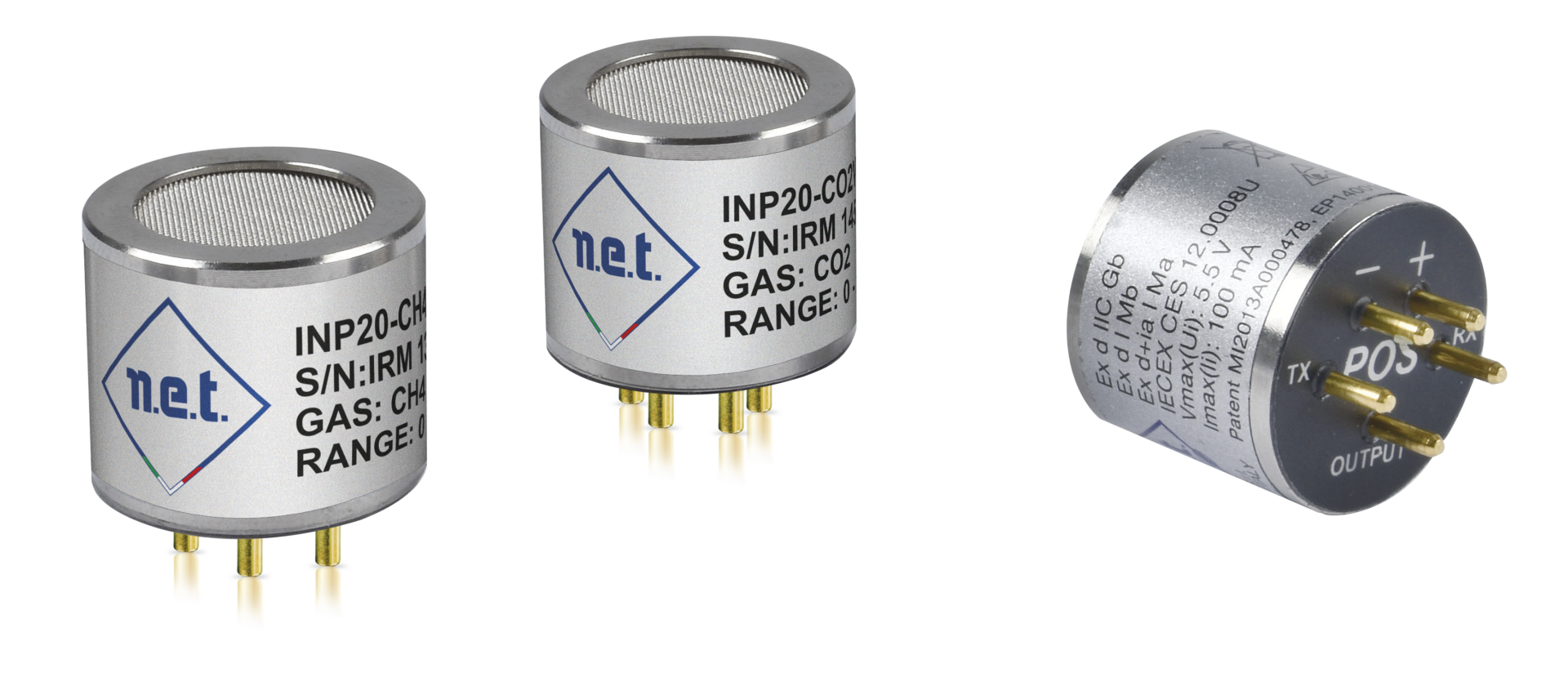
For 25 years, N.E.T. has been committed to developing, improving, and optimizing this technology, which is entirely designed and manufactured in Italy at our headquarters near Milan.
The main operational advantages of our IR sensors are defined by specific technical specifications, which guarantee reliability and precision:
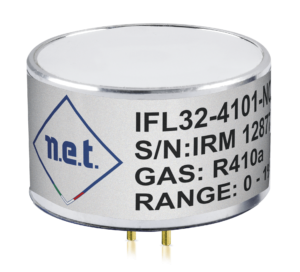
We offer the most comprehensive range of NDIR products on the market, including solutions for:
- CO2 from ppm levels up to 100% volume
- Methane, Propane and other hydrocarbons in explosive range (%LEL)
- SF6 in ppm range
- Refrigerant Gases in ppm and LEL range
To receive technical documentation or customized support reach out to info@nenvitech.com