

Understanding Black Body Radiation: Extending the Frontiers of NDIR Gas Sensing
In the world of Non-Dispersive Infrared (NDIR) Gas detection, the ability to see a Gas molecule depends entirely on the infrared radiation source. At N.E.T., we have engineered our sensors to surpass the limitations of conventional technology by mastering the physics of Black Body radiation.
The Conventional Limit: Filament Lamps
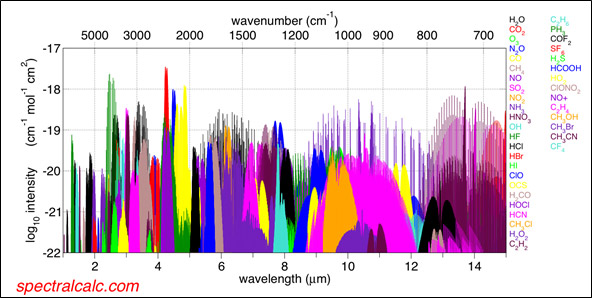
For years, the industry standard for CO2 and hydrocarbon detection has been the classic filament lamp. These components are effective but fundamentally constrained. The glass bulb that encapsulates the filament acts as a filter, which drastically reduces radiation intensity beyond 4.5 µm and effectively blocks all wavelengths greater than 5 µm (or 5000 nm). While this works for simple hydrocarbons, it creates a blind spot for more complex molecules.

What is a “Black Body”?
To detect Gases with absorbance bands beyond 5 µm such as SF6 and refrigerant Gases we must move beyond the constraints of a glass-housed filament. We turn to the physics of the Black Body.
A black body is a theoretical physical body that represents an idealized system:
- Thermodynamic Equilibrium: It is an object that absorbs all incoming electromagnetic radiation, reflecting none.
- Planck’s Law: Because it is an “ideal” emitter, it radiates energy across a continuous spectrum based solely on its temperature, as defined by Planck’s Law.
- Full Spectrum Capability: Unlike a filtered filament, a true black body source emits energy across an infinite range of wavelengths, including the ultraviolet, visible, and the infrared spectrum.
The N.E.T. Solution: MEMS-Based Black Body Technology
By utilizing MEMS technology, N.E.T. integrates a dedicated surface emitter that mimics true black body characteristics. This allows us to extend the emission range of our instruments from 2 to 14 μm, opening the door to the detection of Gases that were previously invisible to traditional NDIR sensors.
Beyond the spectral advantage, our MEMS design offers critical performance benefits:
- Structural Integrity: The monolithic structure provides exceptional resistance against shock and vibration.
- Efficient Energy Management: By using fast electrical modulation, we eliminate the need for mechanical chopper wheels and reduce overall power consumption.
- Precision: High emissivity ensures reliable, repeatable Gas detection across industrial and commercial applications.
- What defines a “Black Body” in the context of infrared sensing? A black body is a physical object that absorbs all incident electromagnetic radiation and emits energy in the full spectrum of wavelengths according to Planck’s law. In Gas sensing, it provides a stable, predictable radiation source necessary for detecting complex Gas molecules.
- Why do standard filament lamps fail to detect refrigerant Gases? Standard filament lamps are housed in Sapphire glass, which blocks infrared radiation beyond 5000 nm (5 µm). Many refrigerant Gases and SF6 have critical absorbance bands in the 8 to 10 µm range, rendering them undetectable by filament-based devices.
- What is the specific wavelength range of N.E.T.’s Black Body sources? Our MEMS-based black body sources provide a wide emission range from 2 to 14 μm, ensuring coverage for the most comprehensive range of NDIR-detectable Gases currently on the market.
- How does MEMS technology improve sensor durability? Unlike fragile, traditional filaments, MEMS sources feature a monolithic structure. This design provides superior mechanical robustness, making the sensors highly resistant to shocks and vibrations typically found in industrial environments.
To receive technical documentation or customized support reach out to info@nenvitech.com
If you’d like to explore this further with us, we look forward to seeing you at Sensors Converge
BOOTH 952